
How the CBT-15 compares to Arbin and Neware battery cyclers.
A side-by-side look at the three most common 8-channel full-cell benches: measurement, speed, software access, and the part most spec sheets leave out, how you control temperature.
- V / I accuracy, of full scale
- <0.015%
- per channel · 4 ranges
- 15 A
- at once, per unit
- 4 temps
- thermal control on the device
- No chamber
Battery cycler specifications, side by side
A check marks the strongest figure in each row, ours or theirs.
| Specification | Cyclone Eye CBT-15 | Arbin LBT | Neware CE-4008Q |
|---|---|---|---|
| Voltage range | 0 – 5 V | −5 to +5 V / 0 – 10 V | 0.025 – 5 V |
| Max current per channel | 15 A (4 ranges) | up to 10 A (4 ranges) | 15 A (4 ranges) |
| Measurement resolution | 24-bit | 24-bit | 24-bit |
| Measurement accuracy (V / I) | <0.015% of FS(strongest in this row) | ±0.02% FSR | ±0.05% FS |
| Current control accuracy | <0.02% of FS | ±0.02% FSR | ±0.05% FS |
| Data sample rate | 1 kHz | 10 kHz burst / 416 Hz regular(strongest in this row) | 10 Hz |
| Current response (0–90%) | <1 ms | ≤100 µs(strongest in this row) | ≤1 ms |
| Thermal control | On-device, per cell, ±25 °C from ambient(strongest in this row) | External chamber required | External chamber required |
| Temperature sensing | PT100 3-wire (K-type option) | RTD PT100 (optional) | Auxiliary module (optional) |
| API / external control | Native API, included(strongest in this row) | Python / C# (paid add-on) | BTS software only |
| Channels per unit | 8 | 8 or 16(strongest in this row) | 8 |
| Price, 8-channel cycler | Low(strongest in this row) | High | Low(strongest in this row) |
| Price with temperature control | Low(strongest in this row) | High (adds a chamber) | High (adds a chamber) |
Competitor figures from published datasheets, October 2026. FS = full scale. Price is relative, for comparable 8-channel benches; request a quote for yours.
A chamber holds one temperature. The CBT-15 holds four.
Temperature is one of the main drivers of cell ageing, so most cycle-life and qualification work runs at controlled temperature. With a conventional cycler, that means a separate environmental chamber, often costing as much as the cycler itself.
One setpoint, controlled on the air
- Every cell in the chamber runs at the same temperature
- Three temperatures means three chambers, or three campaigns in a row
- The control loop reads chamber air, not the cell
- Another instrument to house, power, and maintain
Four setpoints, controlled at the cell
- Each cell channel is paired with a channel that drives its own thermal fixture
- Closed-loop on a PT100 at the cell, not on chamber air
- One 8-channel unit runs four cells at four temperatures in parallel
- Heated formation, grading and dynamic-temperature profiles on the same channels
- No chamber on the bench
Where each cycler fits
Choose the CBT-15 when you need
- Dynamic-temperature studies: each cell follows its own temperature profile, on one bench, without a chamber
- Heated formation and grading: form cells at elevated temperature, then grade them on the same channels
- Tighter measurement accuracy for fade and resistance tracking
- Programmatic control through an API that is included
- Installed and calibrated by the team that built it
Consider Arbin or Neware when you need
- Very fast transients: Arbin’s ≤100 µs current response and 10 kHz burst sampling
- Higher channel density: Arbin’s 16-channel configuration
- Voltage beyond 5 V or bipolar ranges
Already have your own cycling infrastructure? Keep it.
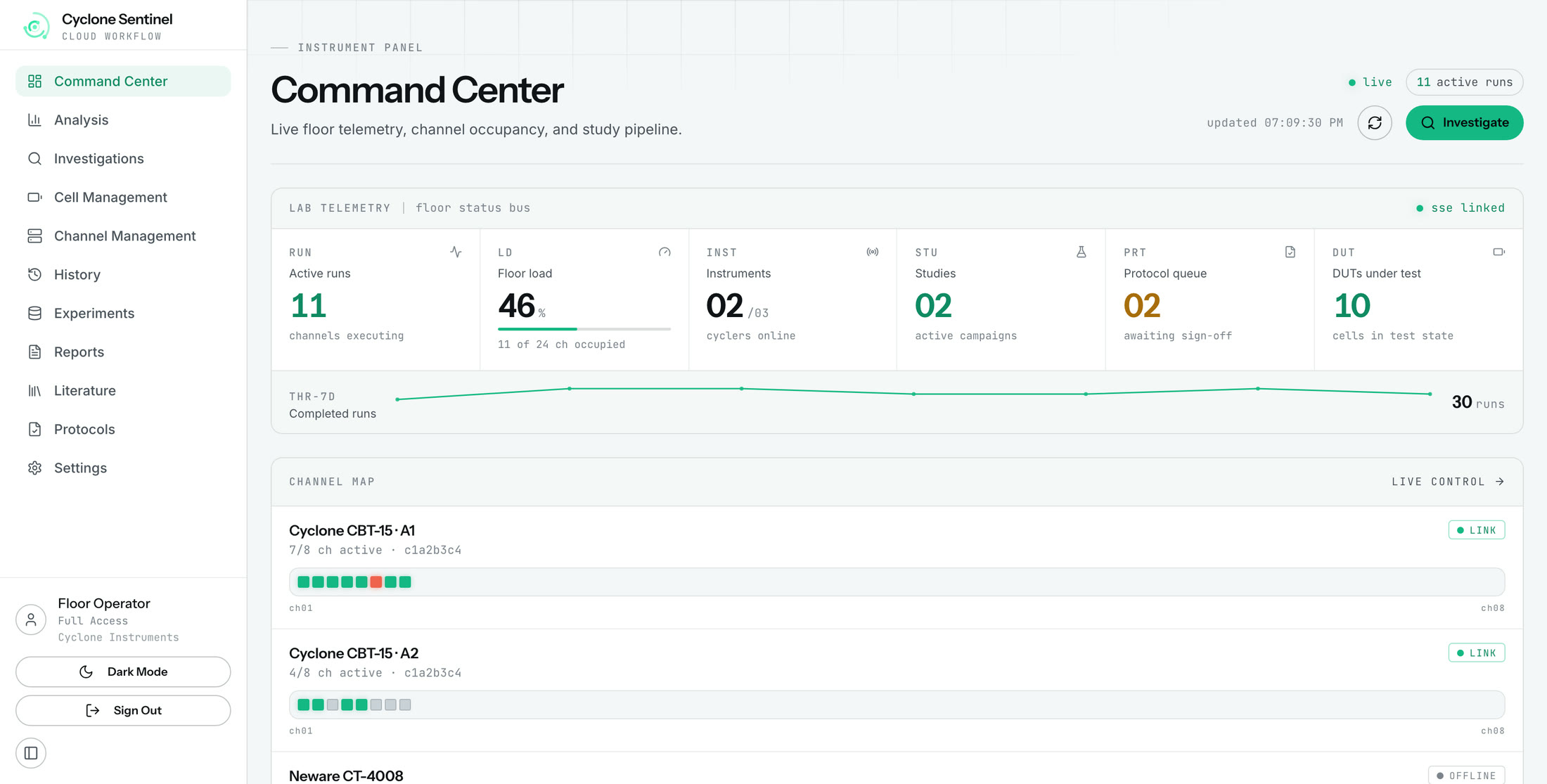
Cyclone Sentinel runs the CBT-15 alongside the cyclers already on your bench, from one place: live floor view, versioned protocols, and investigations when a channel drifts.
Battery cycler questions
Do I need a thermal chamber with the CBT-15?
No. Each cell sits in its own thermal fixture, driven by a paired channel and controlled on a PT100 at the cell, from 25 °C below to 25 °C above ambient.
Can the CBT-15 run alongside our existing cycling infrastructure?
Yes. Cyclone Sentinel runs Cyclone Eye and the cyclers you already have from one place, so the whole floor shares one view, one protocol library and one data store.
How much does a battery cycler cost?
It depends on channel count, current range, and whether you need temperature control. Request a quote and we will price a bench for your test plan, to buy or to lease.
What is the lead time?
About four weeks, with installation and commissioning included.
Does the CBT-15 support EIS?
On-channel electrochemical impedance spectroscopy is on the CBT-15 roadmap. Ask us for the current status when you request a quote.
Types of battery cyclers, and how to choose one
Potentiostats, battery cyclers, formation systems and pack testers: what each type of battery cycler is for, and the specifications that matter when you choose one.
Why per-cell temperature control matters in battery testing
Temperature drives battery ageing. Why controlling temperature at each cell, rather than the air in a chamber, gives cleaner cycle-life data and lets one bench run several temperatures at once.
Your next campaign,from intent to answer.
Talk to the founders about the chemistry, the conditions, and the decision you need to make.